AC repair
Capacitor, contactor, compressor, refrigerant leak. Diagnosed on the first visit, priced before we touch a tool.
78%fixed on the first visit
Animation follows your operating system’s reduced-motion setting unless you override it here. Turning it off stops the thermal field, the pointer tilt and every scroll-driven animation on the site — nothing on this page is explained by movement alone.
These four choices are stored in your browser only, and only if you accepted preference storage. This site has not been audited against WCAG, so it does not claim conformance to it.
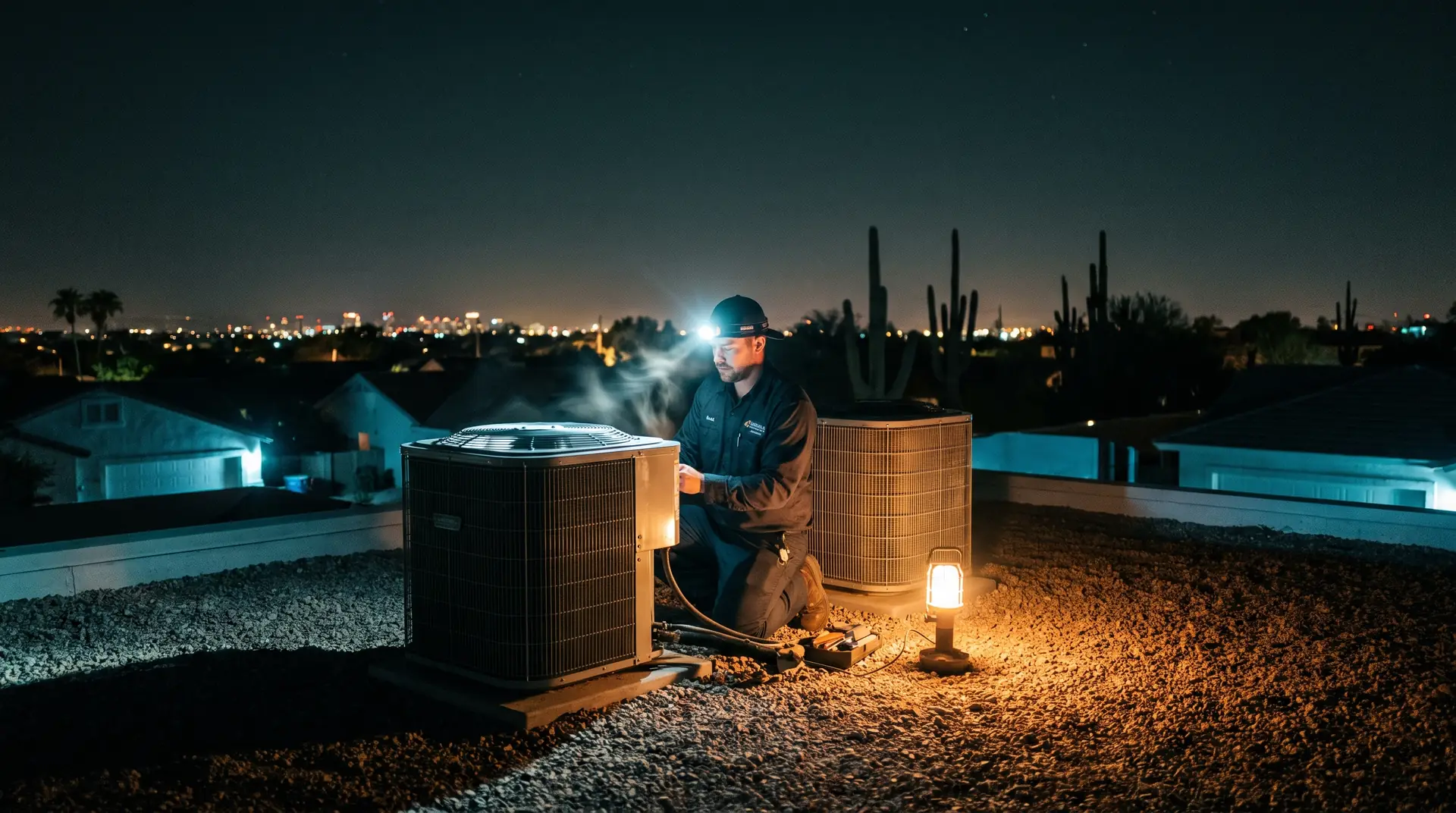
Dispatch online 6 crews in Phoenix
It fails at 2am, or it is fifteen years old and you have three weeks. Those are not the same purchase, so: the bar at the top never moves. That is the 2am answer. Everything below it is the other one.
Residential and commercial, repair and replacement, cooling and heating. Every card carries the number that matters most for that job.
Capacitor, contactor, compressor, refrigerant leak. Diagnosed on the first visit, priced before we touch a tool.
78%fixed on the first visit
Manual J load calculation before a tonnage is quoted. R-454B ready equipment, permit pulled, old unit hauled.
2-5tonresidential sizing range
Gas furnace service, heat exchanger inspection and safety shutdown testing. Phoenix nights hit the thirties.
96AFUEhigh efficiency furnaces
One system, both directions. In a climate that barely freezes, an HSPF2 rated heat pump usually wins on running cost.
8.5HSPF2typical heating efficiency
Static pressure tested, leakage measured. A perfect condenser feeding a leaking attic duct run is a wasted purchase.
0.50in. w.c.target total static pressure
Monsoon dust, construction silt and pollen. Filtration sized to your blower, not sold from a catalogue.
13MERVthe practical Phoenix sweet spot
Rooftop package units, split systems and walk-in refrigeration. Planned maintenance with a named account engineer.
4hrcontract response target
Five steps, the same five every time, whether it is a Tuesday morning tune-up or a Sunday at 3am.
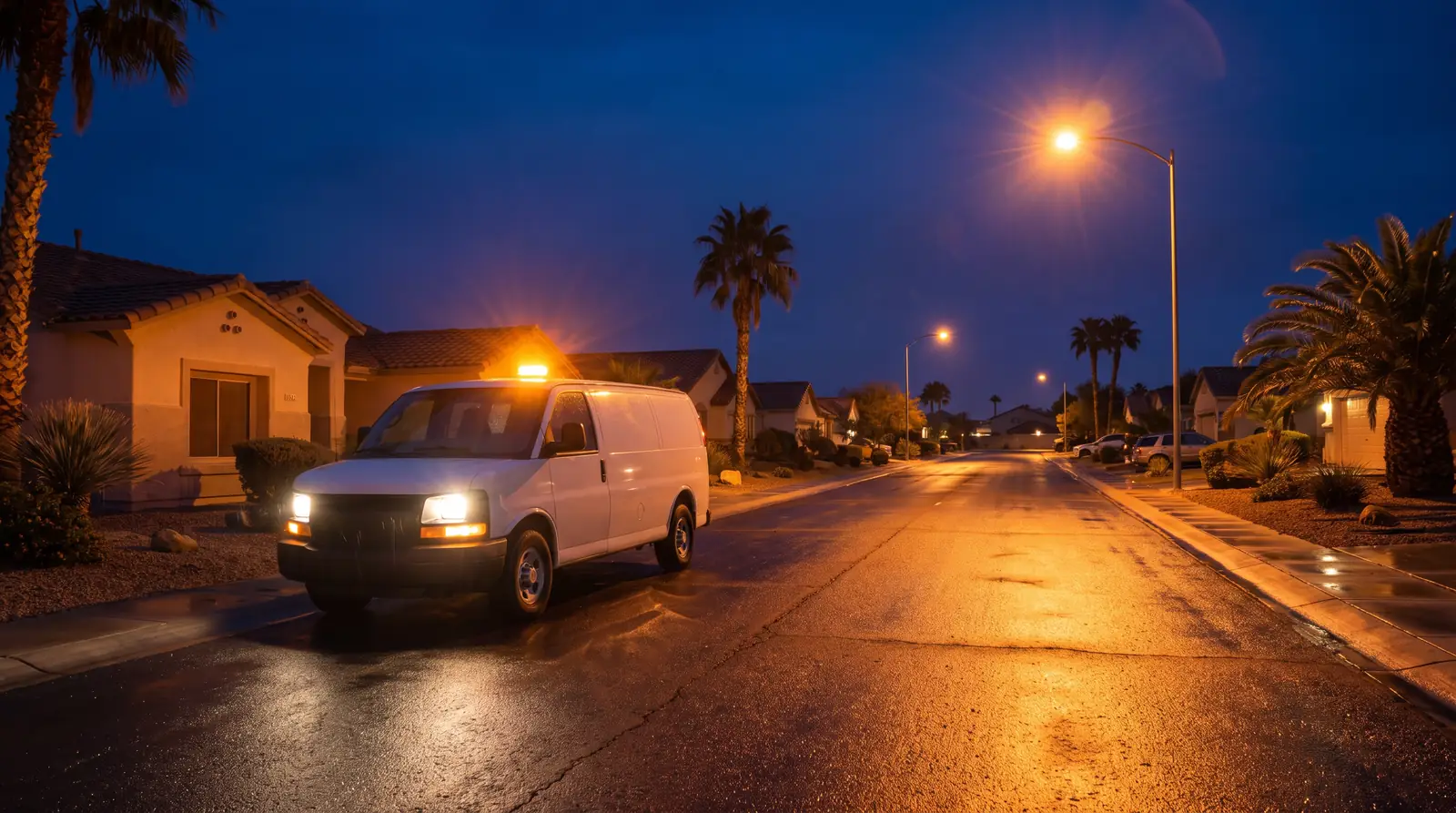
A dispatcher in our Phoenix office picks up, day or night. They ask what the thermostat says, whether the outdoor fan is turning and whether the breaker has tripped, because those three answers decide what goes on the truck.

The board picks the nearest crew with the right parts already on board, not simply the nearest crew. You get a name, a photograph and a live arrival window by text.
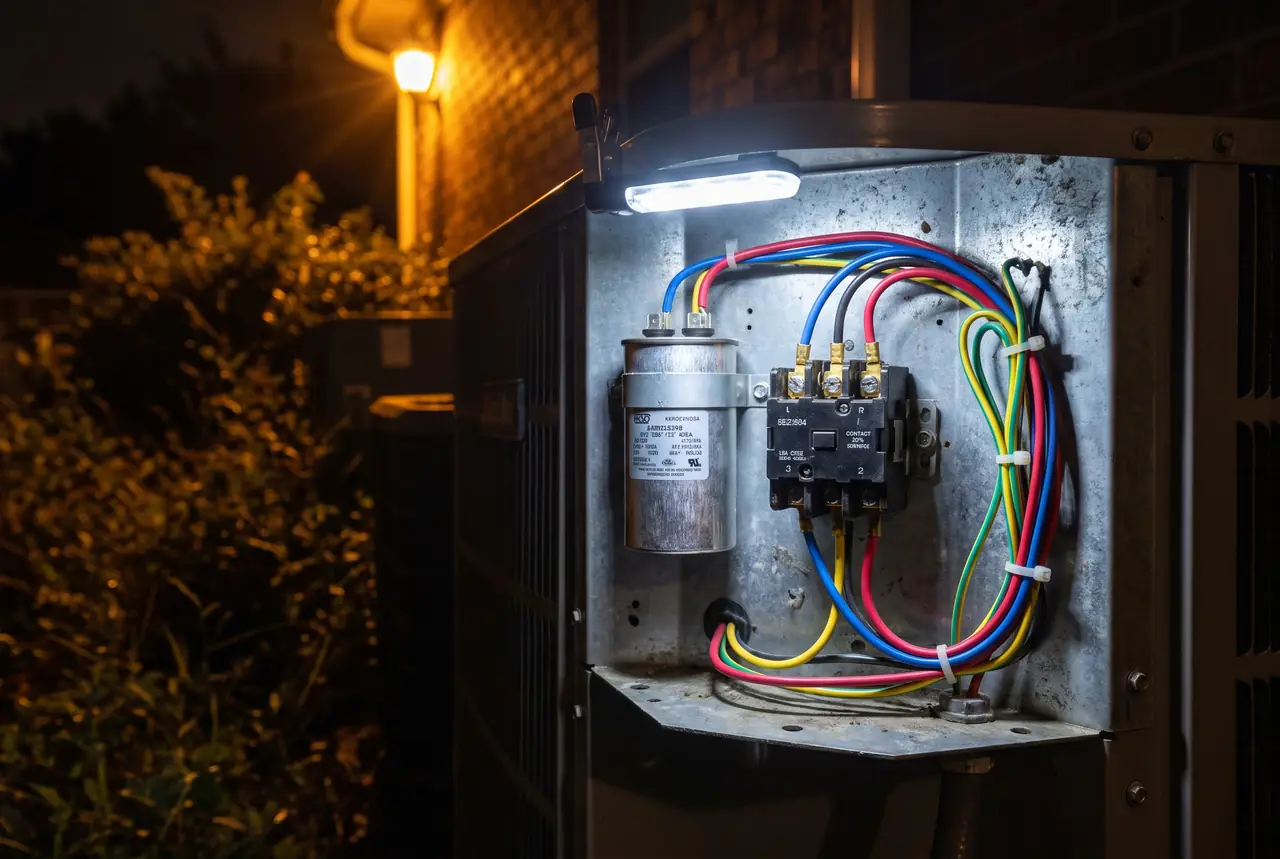
Gauges on, amp clamp on, static pressure measured. We read the system rather than guess at it, and you see the numbers we are reading while we read them.
The price is quoted in writing before a tool is picked up, and it does not move afterwards. Trucks carry capacitors, contactors, motors, ignitors and refrigerant, so most calls end the same night.
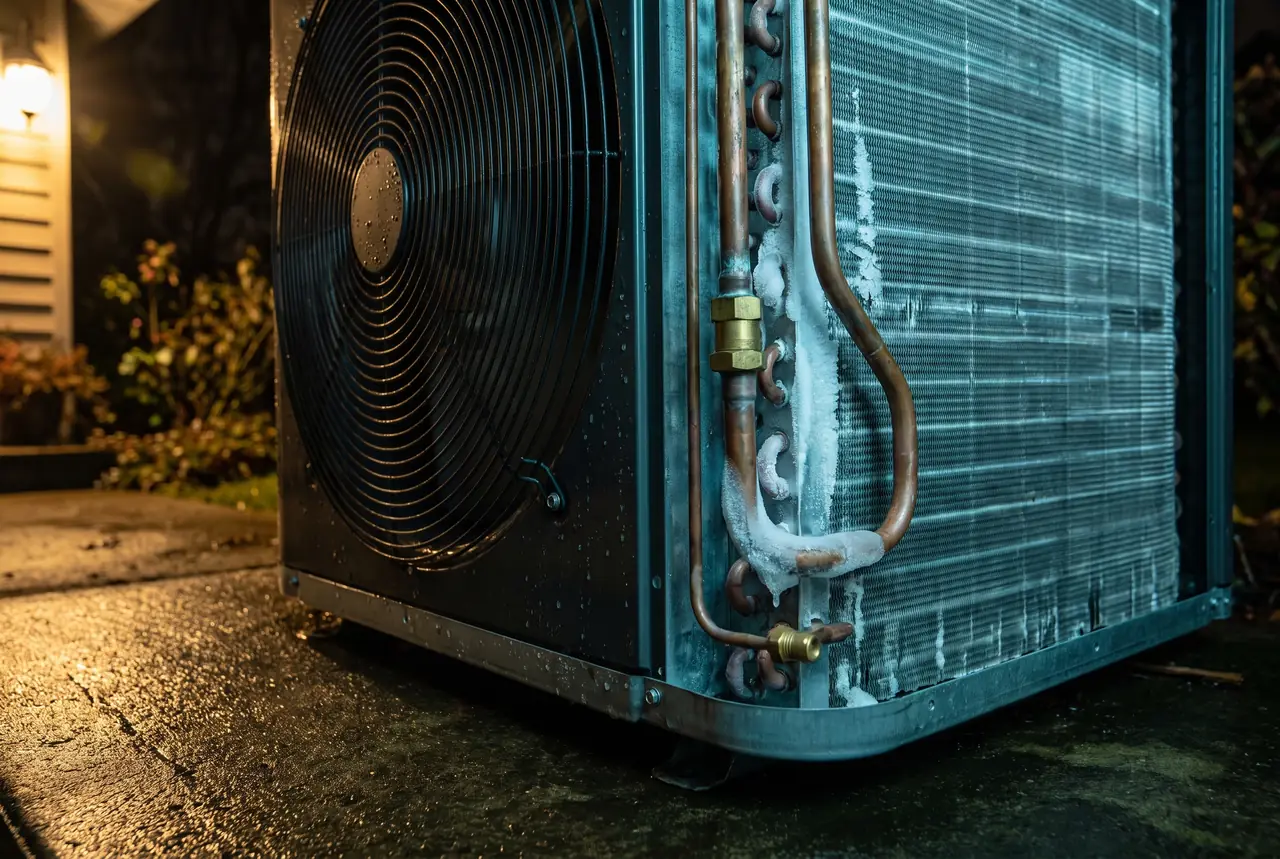
A call two days later to confirm the system is holding, and the readings from your visit go on file so the next technician starts from data rather than from scratch.
Manufacturers rate cooling equipment against a 95 degree outdoor design day. Phoenix spends most of the summer above that, and in 2026 the city ran a record streak of consecutive days at or over 110.
That is why our maintenance specification for a Phoenix home is not the one a manufacturer writes for a national audience. Two coil washes a year, not one.Capacitor microfarad trended rather than merely checked. Static pressure measured on every visit, because a system fighting bad ductwork in this heat does not last.
A condenser rated for 95 degrees is working far outside its comfortable range for three months a year. Head pressure climbs, current draw climbs, and the components nearest the heat give up first.
A haboob drives fine silt straight into the condenser coil. The coil stops rejecting heat, so the compressor works harder for less cooling, and the capacitor beside it cooks.
The Phoenix default puts the indoor unit in a 150 degree attic. Every leak in the supply duct pulls that air into your rooms, and every condensate failure shows up on your ceiling.
Valley water leaves scale in condensate lines and drain pans. A blocked line trips the float switch, the system shuts down, and it reads to a homeowner as a dead air conditioner.

Not testimonials. A demonstration company has no customers, so it has no testimony and no rating. What it can show you is how a fault is reasoned about — which is the thing a review was standing in for.
“Fan is spinning outside, the air indoors is warm”
Ahwatukee Foothills, Phoenix
The compressor never started. A capacitor this far down still turns the condenser fan, which is why the unit looks alive from the driveway and the house keeps getting hotter.
Then: Capacitor replaced, compressor amp draw checked on restart. The part is the cheapest one in the van and the single most common summer failure here.
“Upstairs has been hot for two summers”
Dobson Ranch, Mesa
Not a capacity problem. A zone damper motor had seized shut, so the upstairs branch was being fed whatever leaked past it. Two other quotes on this house proposed a whole new system.
Then: Damper motor replaced, zoning rebalanced. Replacing the system would have fixed nothing and cost roughly forty times as much.
“Back bedroom never gets cold, everything else is fine”
Sunnyslope, Phoenix
Flexible duct crushed above the garage and a return far too small for the air handler. The blower was working against roughly twice the pressure it was designed for, which starves the far runs first.
Then: Return enlarged, two runs replaced, static re-measured after the work. Before-and-after numbers left with the homeowner.
“It cools, then stops, then cools again”
Superstition Springs, Mesa
Low charge, and low charge is always a leak. The evaporator was icing, melting, and short-cycling on the low-pressure switch. Topping it up without finding the leak just sells the same repair again next month.
Then: Leak search first, quoted separately, with the honest warning that a leak in a coil this old usually ends the conversation about repair.
“Nothing at all, and it is 2am”
Old Town, Scottsdale
A blocked drain line tripped the safety and shut the system down on purpose. Valley water leaves scale in the line and this is what it looks like from inside the house: a dead air conditioner.
Then: Line cleared, pan flushed, switch tested. Ten minutes of work that reads to a homeowner like a catastrophic failure.
“Quoted a five ton by three companies”
Arcadia, Phoenix
None of the three quotes measured anything. An oversized system in this climate short-cycles, removes less humidity during monsoon, and wears its compressor out faster than the one it replaced.
Then: Four ton specified. The customer was talked out of the larger, more expensive machine they had already decided to buy.
“Half the block lost power in a dust storm”
Deer Valley, Phoenix
Silt driven into the fins by a haboob. The coil could not reject heat, so head pressure climbed until the system tripped on high pressure. The outage was a coincidence; the coil was the cause.
Then: Coil washed from the inside out, pressures rechecked. Booked a second wash before the following July rather than the single annual visit a national maintenance schedule assumes.
“The kitchen unit died mid-service”
Desert Ridge, Phoenix
A welded, then failed, contactor. On a commercial rooftop this is a twenty dollar part standing between a restaurant and a closed kitchen, which is why it is stocked on every van.
Then: Replaced on the roof, and the second identical unit was checked at the same time because it was installed on the same day by the same crew.
Every case above is composed for this demonstration. The neighbourhoods are real places in the Phoenix metro; the jobs, the readings and the outcomes are written, not recorded. No rating, review count or response-time average is published anywhere on this site, because there is nothing to average.
Coil washes before July, a heat exchanger check before December, and a flag on your address so the board puts you ahead of walk-in calls.
Both seasons covered and your address is flagged for priority on the dispatch board. This is the plan most Phoenix homes should be on.
$26per month
2 visits per year
Start the Dispatch planOne system, one visit a year, and you stop paying the diagnostic fee.
$14per month
1 visit per year
For multi-system homes and anyone who wants the equipment monitored rather than merely visited.
$44per month
3 visits per year, up to 3 systems
A tune-up in March costs a fraction of a compressor in July - and a replacement chosen in spring is chosen on the arithmetic rather than on the first quote that can come today.
Straight answers, including the ones that lose us work.
A person answers, not a voicemail box and not a call centre in another state. Our dispatchers work out of the Phoenix office on a rotating night shift. Between June and September we run two dispatchers overnight because that is when the volume is.
No. Our rate at 2am on a Sunday in July is the same rate as 10am on a Tuesday in February. We took the after-hours premium out in 2019 because in this climate a night-time failure is not a luxury call, it is the normal case.
This site publishes no measured arrival time - no median and no average - because those are a performance record and a company that does not exist has not performed. The minutes beside each zone on the dispatch board are staged demonstration numbers on a timer, and the board says so. What you should expect from a real contractor: a specific window given on the call rather than a range covering the whole day, a note that distance matters (a Surprise or Queen Creek address will not match a central Phoenix one), and a text when the crew is running late instead of silence. Ask for all three before you agree to a visit.
A flat $89, credited against the repair if you go ahead. You get the price of the repair in writing before any work starts. We do not quote hourly, so a slow diagnosis is our problem and not your bill.
Our working rule: if the repair costs more than a third of a replacement and the system is past year twelve, replacement usually wins. Two things override that arithmetic. An R-22 system with a failed compressor is almost never worth repairing because the refrigerant is out of production and the parts supply has dried up. And a system still inside its compressor warranty is often worth keeping even when it looks marginal on paper.
Two reasons. Dust driven into the condenser fins insulates the coil, so head pressure climbs, the compressor works harder and draws more current, and the capacitor sitting next to it cooks. Then the humidity spike loads the evaporator with latent work it does not normally do here, and any marginal system starts freezing up. A coil wash before July is the cheapest insurance in the Phoenix homeowner budget.
Demo console
Each palette is a temperature scale rather than two brand colours: pick one and the whole four-stop ramp is regenerated, including the thermal field in the hero and the convection particles, which are pixels rather than CSS and have to be re-baked. Every palette here was measured in both light and dark before it was offered — the worst text pair across all twelve combinations is 5.03:1. A palette that could not pass is not in this list rather than being corrected at runtime.
Studio mode. The anchors, typeface and identity fields below are the machinery behind those swatches. A visitor never sees them; they are here because ?studio=1 is on the URL.
Generated scale
luminance climbs cool to hotworst ink 5.02:1
The short form used alone. Left empty it follows the first word of the name.
Replaces the four-bar mark. https or a data:image URL.
Some colour on this site carries a condition rather than a company, so a rebrand does not reach it.
Changes apply as you type