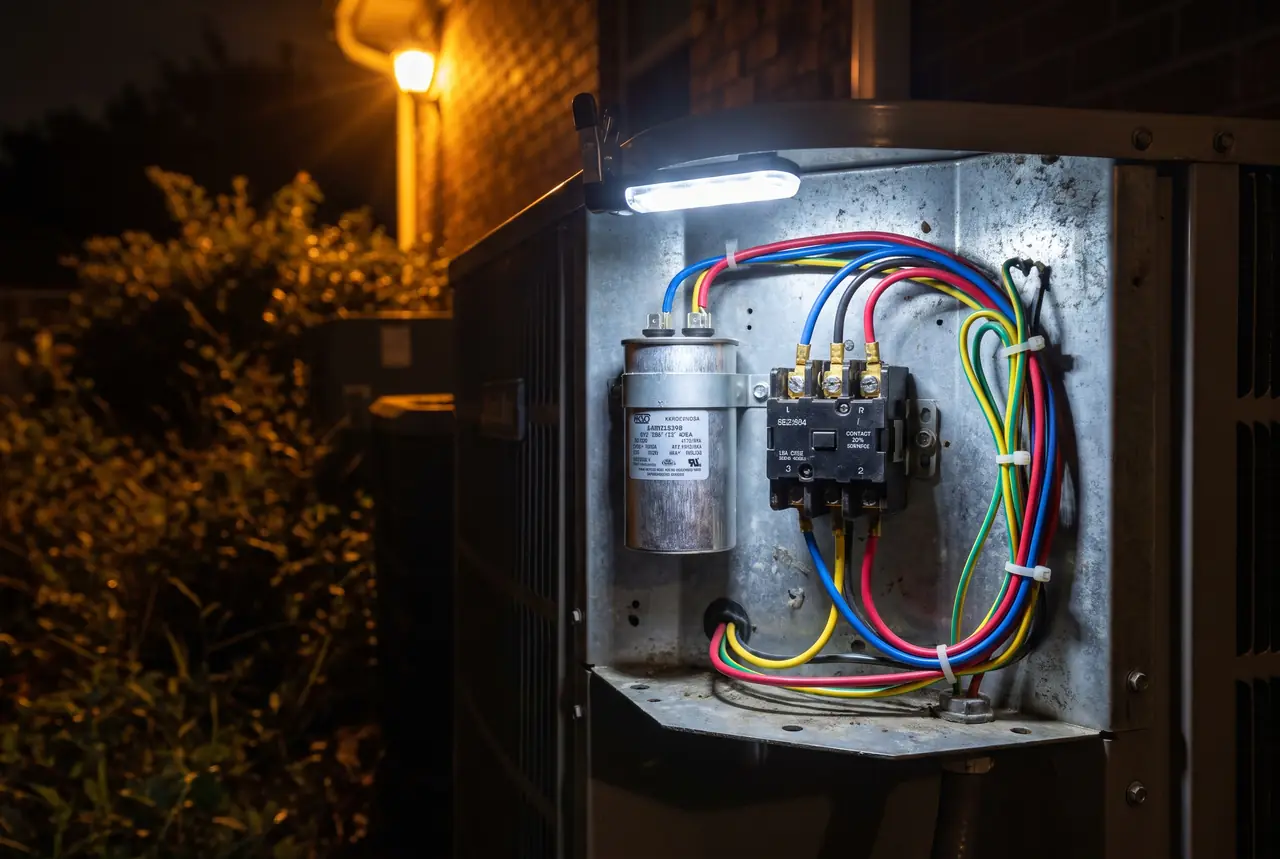
Somewhere between a third and a half of every emergency call we take between June and September comes down to a component that costs us about twelve dollars on the shelf. It is a metal cylinder roughly the size of a soda can, it sits inside the electrical compartment of your outdoor unit, and when it fails your air conditioner stops cooling completely with no warning whatsoever.
What the capacitor does
Your outdoor unit contains two motors that need a great deal of torque to start: the compressor and the condenser fan. A single-phase electrical supply, which is what a house has, cannot on its own produce the rotating magnetic field those motors need to break away from standstill.
The capacitor solves that. It stores a charge and releases it into a second winding on a phase shift, which creates the rotation the motor needs to start turning and then to keep running efficiently. A run capacitor stays in circuit the whole time the system runs. A start capacitor, where fitted, does a brief high-torque job at start-up and then drops out.
Its capacity is measured in microfarads and printed on the case, typically something like45/5 uF for a dual-run capacitor serving both the compressor and the fan. That rating usually carries a tolerance of plus or minus six percent.
Why heat kills it, and why Phoenix kills it faster
A capacitor is a wound film in an electrolyte, sealed in a can. It degrades over time as that film breaks down, and the rate of degradation is driven overwhelmingly by temperature. Manufacturers commonly rate them for operation up to about 70 degrees Celsius, which is 158 Fahrenheit.
Now consider where it lives. It is bolted inside a sheet metal box on the side of a unit that has been standing in direct Phoenix sun since sunrise, next to a compressor that is itself rejecting heat, on a day when the ambient temperature outside that box is already 115 degrees. Internal compartment temperatures well above 150 degrees are entirely normal here in July.
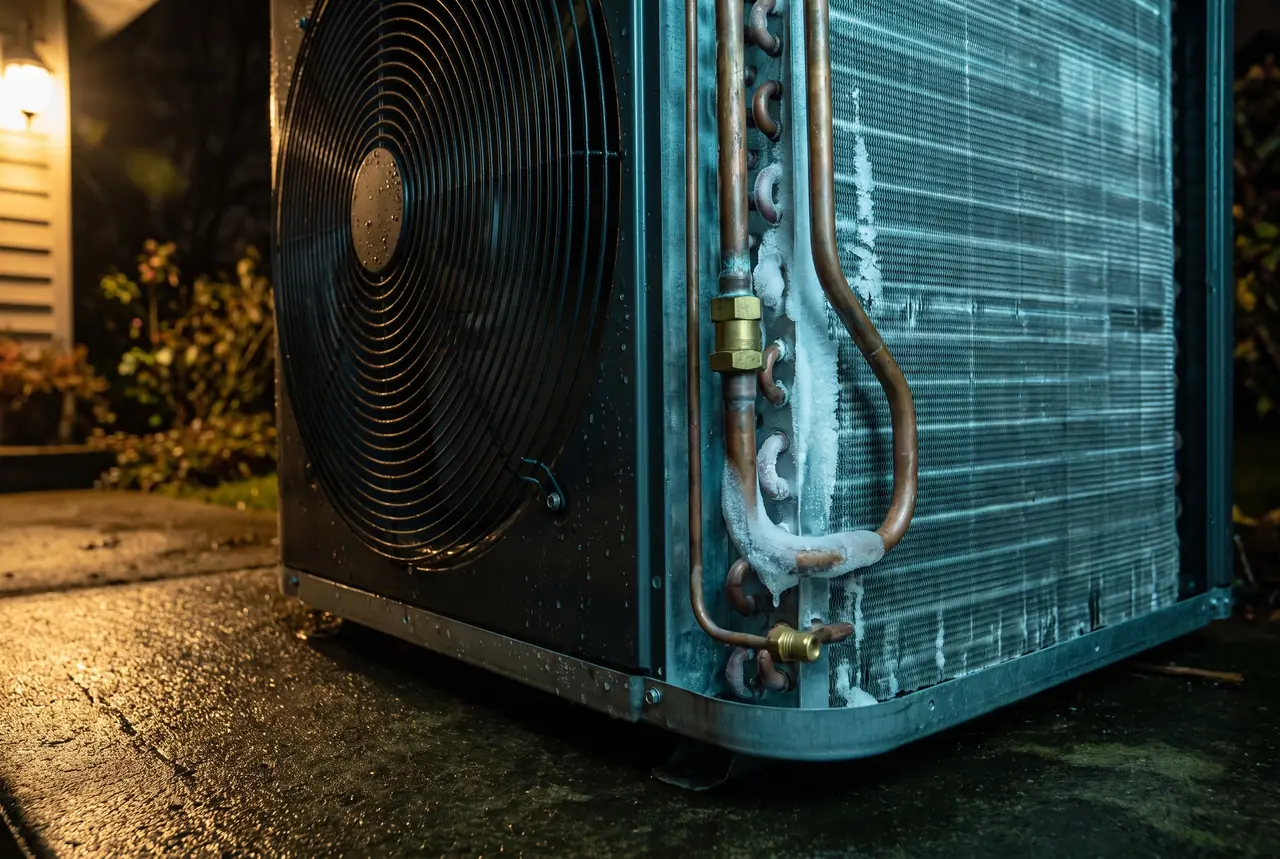
That is why a capacitor rated for a nominal ten-year life routinely fails at five or six years in this valley, and why the failures cluster so tightly into the hottest weeks. It is also why a fouled condenser coil, which raises head pressure and therefore compressor current and therefore compartment heat, shortens capacitor life as a side effect. The monsoon dust problem and the capacitor problem are the same problem.
What you will actually notice
- The outdoor fan is not turning, but you can hear a hum from the unit.
- The thermostat is calling for cool and the indoor blower is running, but the air from the registers is not cold.
- The system starts, runs for a few seconds and shuts down again, repeatedly.
- You spin the outdoor fan blade with a stick through the grille and it then keeps turning. That is close to a definitive symptom, and you should not do it.
- A bulged or domed top on the capacitor can, if you happen to see one. A flat top is not proof it is healthy.
The hum matters. A compressor that hums and does not start is drawing locked rotor current, which is roughly five to seven times its normal running current, through windings that are not moving air over themselves. Every minute you leave it in that state is a minute of thermal damage. Switch the thermostat off, not up.
What a fair repair costs
In the Phoenix market a dual-run capacitor replacement, including the diagnostic and the part, sits somewhere around $180 to $340 depending on the rating and the hour. That is the honest range and we publish it because the alternative is worse.
The reason this repair has a reputation is that a homeowner in a hot house at 9pm has almost no leverage. We have seen invoices in this valley over $600 for exactly this job, and we have seen a failed capacitor used as the opening move in a conversation about a complete system replacement. If a contractor quotes replacement off the back of a dead capacitor with no other evidence, get a second opinion.
Our technicians are not on commission, which is the structural reason we can afford to say that. Nobody here earns more by turning a $220 repair into a $9,000 sale.
Why not to do it yourself
The part is available online for around fifteen dollars, and there is no shortage of videos. We will still tell you not to.
A capacitor stores charge after the power is disconnected. A 45 microfarad capacitor charged to 370 volts holds enough energy to injure or kill you, and it does not care that you switched off the breaker. It has to be discharged deliberately, with an appropriate resistor, before anything touches those terminals.
Beyond the safety issue there is a diagnostic one. A capacitor that has drifted out of tolerance is often a symptom rather than a cause. A compressor drawing high current because the coil is fouled, or a fan motor with failing bearings, will destroy the replacement capacitor as well. Swapping the part without measuring compressor and fan amperage means you get to do the job again in three weeks.
How to see it coming
This is the one common HVAC failure that genuinely is predictable, because capacitance degrades gradually before it fails outright.
On every maintenance visit we measure the capacitor with a meter and write the actual microfarad reading on your file next to the nameplate rating. A capacitor stamped 45 that reads 43.1 this spring and 41.8 next spring is on a trajectory, and we can replace it in March for the same price it would cost in July, at a time when your house is not 95 degrees.
Alongside that, the coil wash matters more than it sounds. Keeping the condenser clean keeps head pressure down, which keeps compressor current down, which keeps the temperature inside that electrical compartment down. It is the cheapest thing you can do to extend the life of the most common failure point in a Phoenix air conditioner.