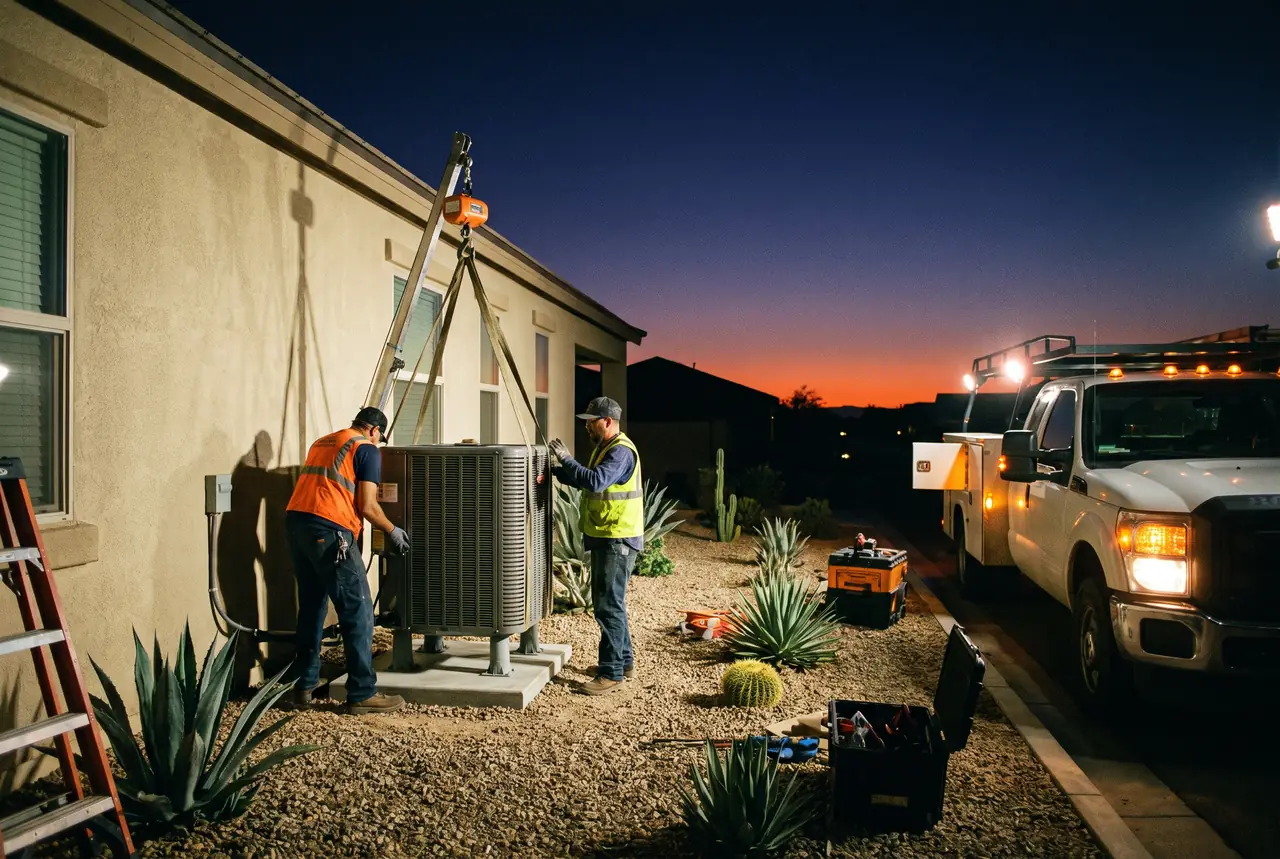
A new system, quoted after the load calculation and not before
We will not give you a tonnage over the phone. Oversized equipment short-cycles, never dehumidifies, and dies years early. It is the most expensive mistake in this trade.
- residential range we install
- 2-5 ton
- our most-fitted efficiency
- 17.2 SEER2
- financing available
- 0% APR
- typical parts warranty
- 10 yr
Manual J, and why we will not skip it
A Manual J load calculation is the ACCA standard method for working out how much cooling a specific building actually needs. It is room by room, it takes about an hour of measuring, and it is included in every replacement quote we write.
The alternative, still common in this market, is 500 square feet per ton. That rule reliably produces a system half a ton to a full ton too big. An oversized system satisfies the thermostat quickly, shuts off, and never runs long enough to pull moisture out of the air, which is exactly what you need it to do during monsoon.
Orientation and glazing
West-facing glass in Phoenix is a heat source, not a window. Every pane is measured, oriented and shaded or not.
Insulation and infiltration
Attic R-value, wall construction, and a blower-door-informed estimate of how much 115 degree air is leaking in.
Duct losses
Ducts in a 150 degree attic add load that a floor-area rule of thumb ignores completely. This is where most estimates go wrong.
Occupancy and appliances
People, cooking, and the west-wall office with two monitors in it all become sensible load on the calculation.
Roughly where a Phoenix home lands
Indicative only. The square footage bands below overlap on purpose, because two identical-looking homes on the same street can differ by a full ton once the glazing and the attic are measured.
- 2.0ton24,000 BTU/h900 to 1,300 sq ftCasitas, condos and small older ranch homes.
- 2.5ton30,000 BTU/h1,200 to 1,600 sq ftThe most common replacement size we fit in central Phoenix.
- 3.0ton36,000 BTU/h1,500 to 1,950 sq ftTypical 1990s and 2000s three-bedroom subdivision build.
- 4.0ton48,000 BTU/h1,900 to 2,600 sq ftLarger two-storey homes, or one zone of a zoned system.
- 5.0ton60,000 BTU/h2,500 to 3,300 sq ftThe largest single residential unit. Beyond this, two systems.
What is in the price, itemised
Six things separate a good installation from a cheap one, and five of them are invisible once the panels are back on.
Refrigerant
R-454B
The lower global warming potential refrigerant now standard on new equipment under the AIM Act phase-down.
Line set
Flushed
Or replaced. An old line set carrying residue from a burnt-out compressor will kill the new one.
Permit
Pulled
City mechanical permit and inspection, arranged by us. An unpermitted changeout is a problem at resale.
Pad and clearances
Level
A new pad where the old one has settled, and the manufacturer clearance the warranty depends on.
Vacuum
500 micron
Held and proved with a micron gauge. Moisture left in the circuit becomes acid and eats the compressor.
Old equipment
Hauled
Refrigerant recovered to EPA rules, metal recycled, and nothing left on your driveway.
A replacement is rarely a planned purchase
Almost nobody budgets for a system that fails in July. Approved applicants can spread it, and the plans we offer include a genuine 0% APR option rather than a deferred-interest trap.
See the financing terms- 0% APR
- 18 months, on approved credit
- From $89
- a month on longer terms
- Same day
- decision, soft check first
Buying questions
What size system do I need?
That is what a Manual J load calculation answers, and it is the only honest answer. It accounts for your square footage, orientation, glazing, insulation, infiltration and duct losses. Rules of thumb like 500 square feet per ton produce oversized equipment that short-cycles, never dehumidifies and dies early. We run the calculation before quoting, and we will show you the output.
What is SEER2 and does a higher number pay for itself?
SEER2 replaced SEER in 2023 and is measured against a higher external static pressure, so it reflects real installed ducting rather than a laboratory ideal. A SEER2 number roughly 4.5% lower than the old SEER figure describes the same machine. Whether extra efficiency pays back depends on your runtime. In Phoenix, with 3,000 or more cooling hours a year, the step from 14.3 to 16 SEER2 usually pays for itself. The step from 18 to 22 often does not, and we will say so.
What is happening with R-410A and R-454B?
Under the AIM Act, new residential systems manufactured from 2025 use lower global warming potential refrigerants, in practice mostly R-454B. R-410A is not illegal and your existing system is fine, but the supply is being phased down and the price is rising. That matters for the repair or replace decision on an older R-410A system with a significant leak.
Heat pump or gas furnace?
In the Phoenix valley the heat pump usually wins. We see roughly 1,100 heating degree days a year, so the heating season is short and mild, and a heat pump running at an HSPF2 of 8 or better delivers that heat for less than gas at current Arizona rates. The case for gas gets stronger at elevation, and for homes that already have a sound gas line and a furnace with years left in it.
Book the load calculation, not a sales visit
An hour of measuring, a written Manual J output, and a quote you can take to another contractor if you want to.