Everyone in this trade tells homeowners that monsoon dust is bad for an air conditioner. Almost nobody puts a number on it. So during the 2026 season we logged readings on twelve Phoenix systems before and after the dust, and this is what came back.
A note on rigour up front: twelve systems is a small sample from one company's own customer base, and this is a demonstration website rather than a peer-reviewed study. Treat the figures as indicative of the direction and rough magnitude, not as a controlled experiment.
What we measured
Twelve residential split systems across Phoenix, Mesa and Tempe, between two and eleven years old, all with reasonably clean coils at the start of the window. On each one we recorded, in mid-June and again in mid-September:
- Compressor running current, in amps, with a clamp meter at steady state.
- Liquid line pressure converted to saturated condensing temperature.
- Condenser split, meaning saturated condensing temperature minus outdoor ambient.
- Delta T across the evaporator coil.
- Total external static pressure across the air handler.
Readings were taken within a two degree band of the same outdoor ambient at both visits, because comparing a June morning to a September afternoon would tell you nothing.
What the numbers showed
Across the twelve, after a season of monsoon outflow and no intermediate coil wash:
- Compressor current rose by 8 to 14 percent at matched ambient. The mean was around 11 percent.
- Condenser split widened by 6 to 11 degrees. A healthy split is roughly 20 to 30 degrees above ambient. Several systems finished the season above 38.
- Delta T narrowed by 2 to 4 degrees on the systems that also had loaded filters, meaning less cooling delivered per pass.
- Static pressure rose by 0.05 to 0.18 in. w.c. on the indoor side, almost entirely attributable to filter loading rather than to duct changes.
Two of the twelve had tripped their high pressure switch at least once during August. Both of those were the units with the widest condenser split, and neither had any other fault when we washed the coil and retested.
Why a dirty coil costs so much
The condenser coil has exactly one job: reject the heat the system collected indoors into the outdoor air. Silt packed into the fin gaps insulates it and reduces the surface area doing that work.
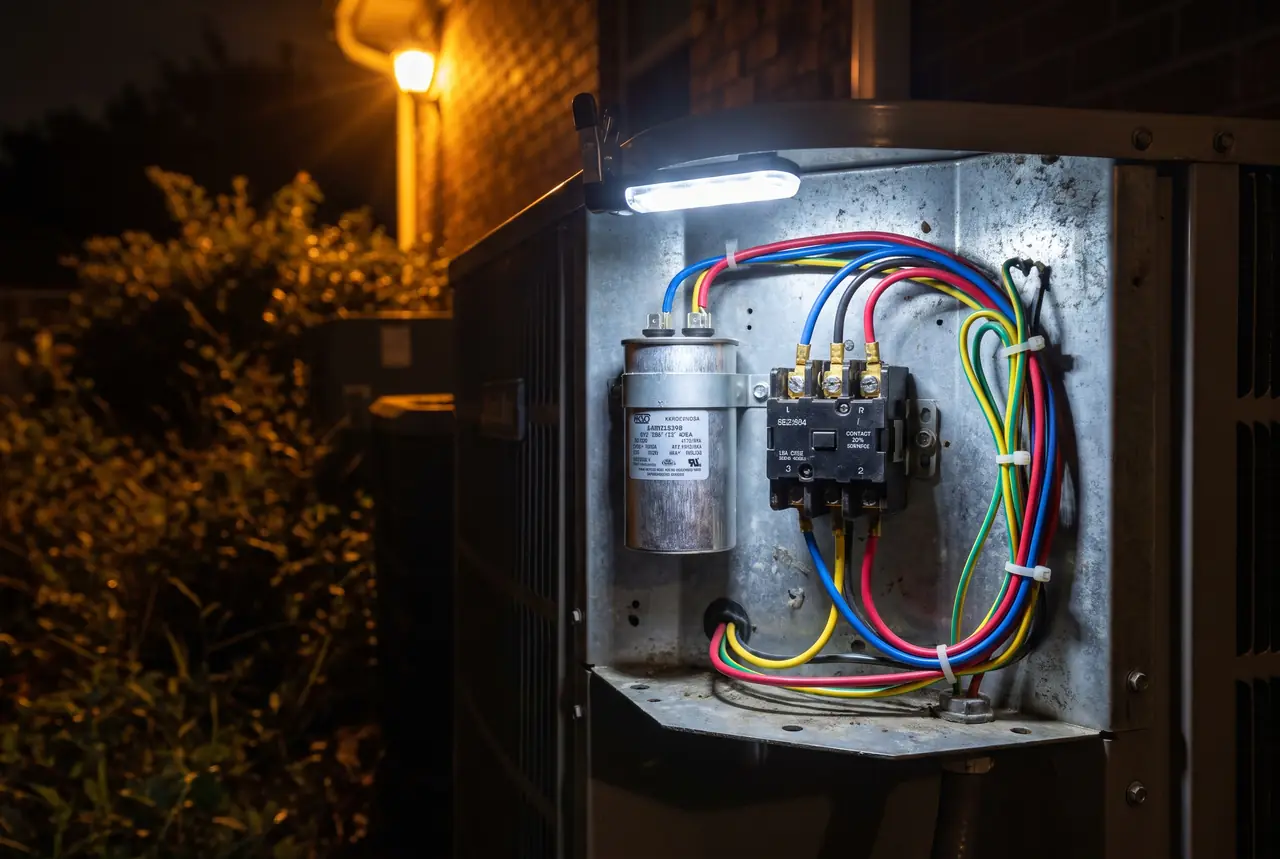
When heat cannot leave, condensing pressure rises. The compressor is now pumping against a higher head, so it draws more current for the same amount of cooling. Higher current means more heat inside the compressor and inside the electrical compartment, which is exactly the condition that kills run capacitors and pits contactor points. That is why the monsoon dust problem and the capacitor failure problem are, mechanically, the same story.
An 11 percent rise in compressor current is not a rounding error. On a system running 3,000 hours a year, that is a real number on your bill, and it is being paid for by compressor wear as well as by kilowatt hours.
What happens on the indoor side
Monsoon does two things indoors at once. It loads the filter with fine particulate far faster than a normal month, and it raises humidity in a way Phoenix homeowners are not used to.
A loaded filter raises static pressure and reduces airflow across the evaporator. Reduced airflow lowers coil temperature, and if it drops far enough the coil starts freezing. A frozen coil looks to a homeowner exactly like a refrigerant problem, which is one reason a genuine leak diagnosis in August has to start by ruling out airflow.
Meanwhile the humidity spike gives the system latent work it does not normally do here. An oversized system, which is common, satisfies the thermostat quickly and shuts off before it has removed much moisture. The house reads clammy at a set point that was comfortable in May. Lowering the thermostat does not fix that, and lowering it is what most people try.
The schedule we now recommend for Phoenix
Two coil washes a year, not one. This is why our maintenance specification differs from what a manufacturer writes for a national audience.
- March or April. Full cooling tune-up, coil wash, capacitor microfarad reading, charge verified, static pressure logged. Before the first 110 degree day.
- Late August or early September. Second coil wash after the worst of the outflow season, plus a condenser split check to catch what the dust did.
- Monthly filter changes, June through September. A filter that lasts three months in winter will not last one in a dust month.
- Immediately after a major haboob. If a visible dust wall passed over your neighbourhood, rinse the outdoor coil yourself within a day or two.
What you can safely do yourself
Two things, and one thing to leave alone.
Rinse the outdoor coil. Switch off the disconnect beside the unit, then spray the coil from the inside outward with a garden hose at normal pressure, pushing the debris back out the way it came in. Straight through the fins, never at an angle.
Change the filter. Note the size printed on the frame, buy several, and change them monthly through the dust season. Do not upgrade to a much higher MERV rating in the same one-inch slot, because the pressure drop will cost you more than the filtration gains you.
Do not use a pressure washer. Condenser fins are thin aluminium and they bend at surprisingly low pressure. Once they are flattened, airflow through that section of coil is permanently reduced and the only fix is a fin comb and a great deal of patience, or a new coil.