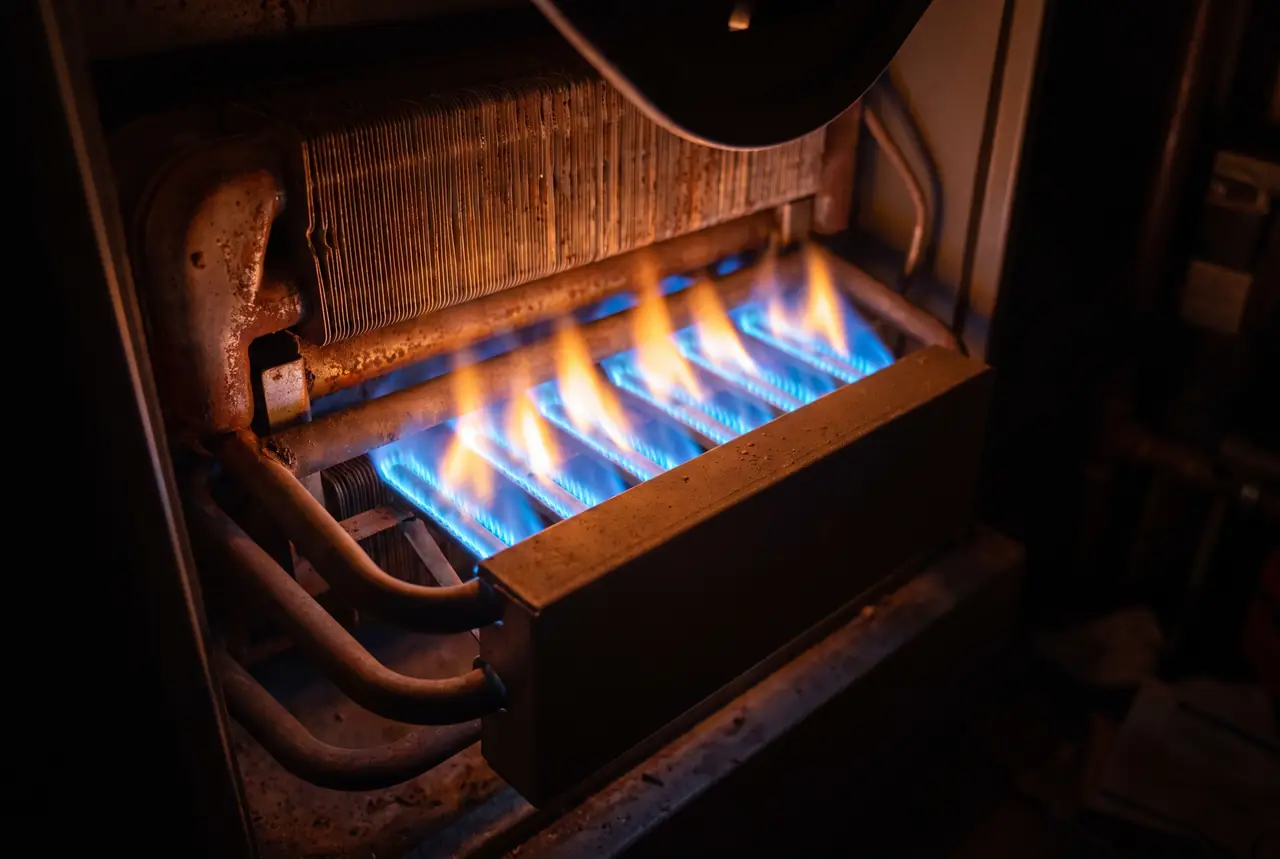
Heating service, for the six weeks a year it matters
The valley averages about 1,100 heating degree days and drops into the thirties overnight in December. A furnace that sat idle for ten months does not always wake up.
- typical Phoenix heating season
- 1,100 HDD
- high efficiency furnaces
- 96% AFUE
- our CO action threshold
- 9 ppm
- no-heat calls answered
- 24/7
The inspection nobody sees, and the only one that is a safety issue
Cooling failures are miserable. Heating failures can be dangerous. A gas furnace burns fuel inside your house, and the wall between that combustion and your air is a metal heat exchanger that fatigues with every heating cycle.
If we find a cracked heat exchanger we red-tag the appliance and shut off the gas. We will say so plainly, we will show you what we found, and we will not relight it. That is not a sales tactic, it is the only defensible thing to do.
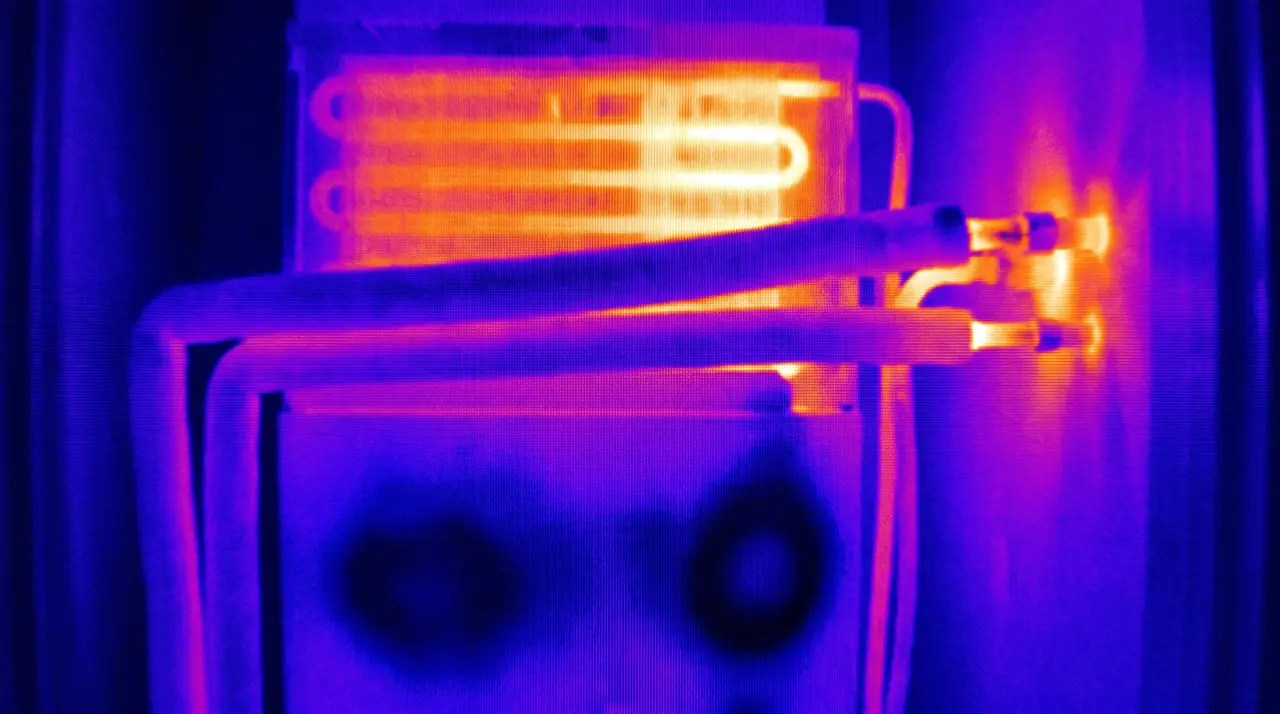
Heat exchanger, visually and by camera
Every accessible cell inspected for cracks and separation. A cracked exchanger puts combustion gas into the air you breathe.
Combustion analysis
A probe in the flue reading oxygen, carbon monoxide and stack temperature. Numbers, recorded, rather than an opinion about the flame colour.
Ambient CO test
A reading taken in the living space with the furnace running. Above 9 ppm we stop and investigate rather than finish the tune-up.
Safety shutdown proving
Flame sensor, rollout switch, limit switch and pressure switch each tested to prove they actually shut the appliance down.
What a cold December morning usually turns out to be
Gas furnaces fail in a small number of predictable ways, and most of them are inexpensive.
Blower runs but the air is cold
Ignition or flame sensing
A dirty flame sensor or a failed hot surface ignitor. The furnace tries, fails to prove flame, and locks out into blower-only.
$180 to $420
this week
Clicks three times then stops
Ignition lockout
Three failed attempts and the board gives up by design. The cause is usually the ignitor, the gas valve or a blocked flue.
$180 to $760
this week
Loud whine or grinding from the cabinet
Inducer or blower motor
Bearings on the draft inducer or the blower wheel. Catching it early is a motor. Leaving it becomes a motor and a board.
$420 to $980
this week
Burning smell on the first cold night
Dust burn-off
Ten months of dust on a heat exchanger that has not run. Normal, and it should clear within twenty minutes. If it does not, switch it off and call.
No charge
plan it
Carbon monoxide alarm sounds
Stop and leave
Open windows, get everyone outside, then call the gas utility before you call us. This is the one line on this board that is not a repair question.
Call 911 first
call now
Typical Phoenix-metro ranges for this demo site, parts and labour included. Any carbon monoxide finding stops the job and changes the conversation.
What the ratings actually mean
AFUE
80 to 96%
Annual fuel utilisation efficiency: how much of the gas becomes heat in your rooms rather than heat up the flue.
HSPF2
7.5 to 9.5
The heat pump equivalent. Higher is better, and in this climate a heat pump usually beats gas on running cost.
Stages
1 or 2
A two-stage furnace runs long and low most of the time, which is quieter and holds a steadier temperature.
Blower
ECM
A variable-speed electronically commutated motor uses a fraction of the electricity of an older PSC blower.
Venting
Cat I / IV
A 96% furnace condenses and vents in PVC. Swapping an 80% for a 96% means new venting, and that belongs in the quote.
Strip heat
5 to 20 kW
Electric backup on a heat pump. Sized to cover the coldest morning without becoming your whole winter bill.
Heating questions
Heat pump or gas furnace?
In the Phoenix valley the heat pump usually wins. We see roughly 1,100 heating degree days a year, so the heating season is short and mild, and a heat pump running at an HSPF2 of 8 or better delivers that heat for less than gas at current Arizona rates. The case for gas gets stronger at elevation, and for homes that already have a sound gas line and a furnace with years left in it.
Should I repair or replace?
Our working rule: if the repair costs more than a third of a replacement and the system is past year twelve, replacement usually wins. Two things override that arithmetic. An R-22 system with a failed compressor is almost never worth repairing because the refrigerant is out of production and the parts supply has dried up. And a system still inside its compressor warranty is often worth keeping even when it looks marginal on paper.
Are you licensed?
Yes, licensed, bonded and insured with the Arizona Registrar of Contractors. This is a demonstration website, so the licence number shown in the footer is an obvious placeholder rather than a real registration. On a live site you should be able to take the number straight to the ROC website and verify it, and you should do exactly that with any contractor you hire.
No heat this morning?
Same crews, same rate, same night. A no-heat call in December is dispatched exactly like a no-cooling call in July.