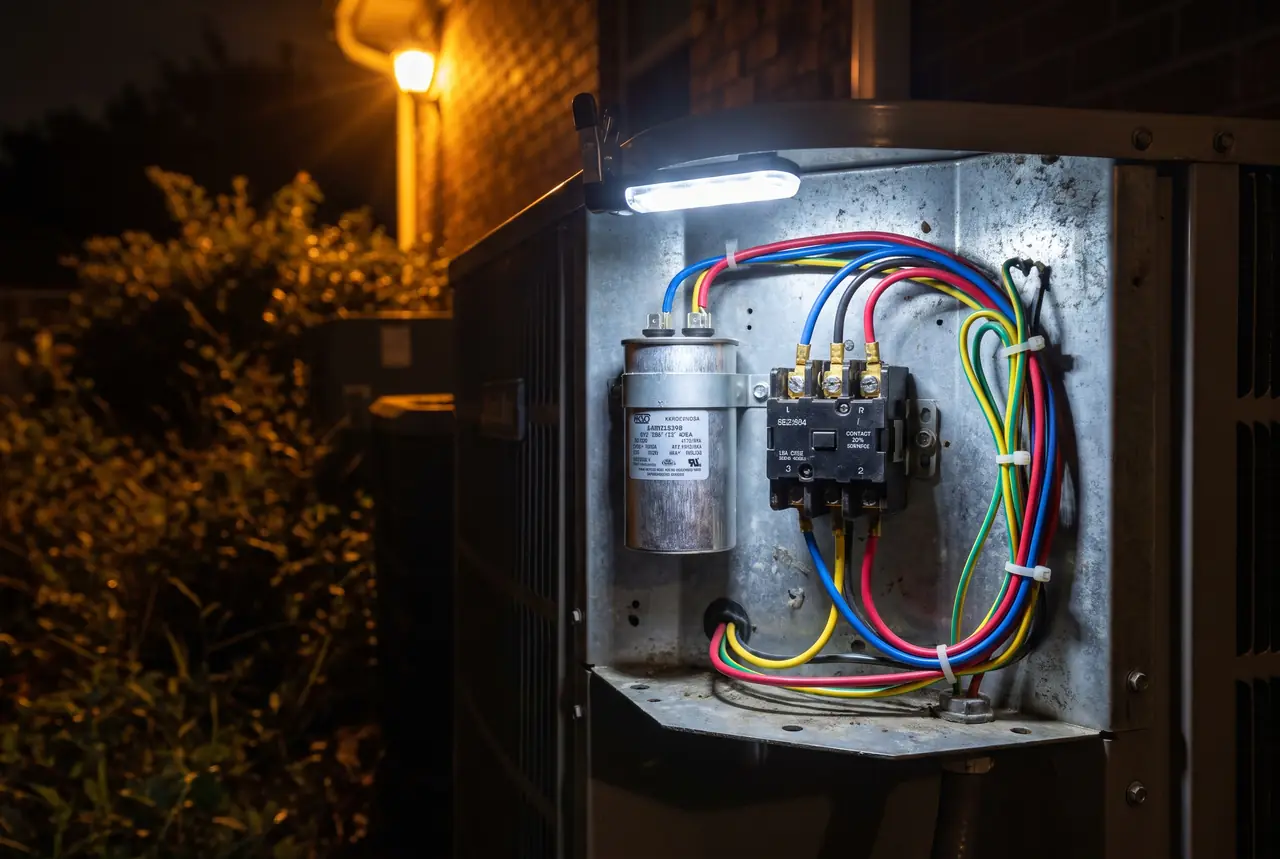
AC repair, 24 hours a day, across the Phoenix metro
Most failures on a Phoenix summer night are one of four parts. We carry all four on every truck, so the call usually ends the same night it started.
- median arrival
- 47 min
- fixed on the first visit
- 78%
- flat diagnostic, credited
- $89
- after-hours premium
- $0
What you are seeing, and what it usually is
Tell the dispatcher which line matches and the right parts leave the depot with the truck.
Fan outside is still, air inside is warm
Run capacitor
The most common summer failure by a wide margin. A cheap cylinder that dies from heat, and the compressor cannot start without it.
$180 to $340
call now
Loud hum, then nothing, sometimes a click
Contactor
Pitted or welded contacts stop passing current to the compressor. Often fails alongside the capacitor, so we replace both.
$220 to $380
call now
Ice on the copper line at the indoor unit
Airflow or refrigerant
A blocked filter, a failing blower or a low charge. Turn the system off and let it thaw before we arrive, or we cannot read the gauges.
$140 to $1,400
call now
Runs constantly and never reaches the set point
Charge, coil or sizing
In July a correctly sized system can legitimately run most of the day. We measure delta T and superheat before calling it a fault.
$89 to $2,200
this week
Water on the ceiling or around the air handler
Condensate drain
Hard-water scale blocks the trap, the pan overflows and the float switch shuts the system down. Common on attic installations.
$140 to $420
call now
Breaker trips again as soon as it is reset
Electrical fault
Leave it off and say so on the call. A repeatedly reset breaker on a shorted compressor is how a repair becomes a fire.
$180 to $2,600
call now
Ranges are typical Phoenix-metro prices for this demo site and include parts, labour and the credited diagnostic. Your quote is agreed in writing before any work starts.
Refrigerant leaks: found, not topped up
A system that is low on refrigerant did not use it up. Refrigerant is not consumed; it is contained. If the charge is low, there is a hole, and putting more gas into a system with a hole is a service call you will make again next summer.
With R-410A now in phase-down under the AIM Act, the price of doing that repeatedly is climbing every year. So we find it, price the repair, and tell you honestly when a coil leak on a fourteen-year-old system means the arithmetic has moved to replacement.
Electronic detection first
A heated diode sensor walked along every joint, coil face and service port. Fast, and it finds most leaks on the first pass.
Nitrogen pressure test
Where the sensor is ambiguous, we isolate sections and hold dry nitrogen to prove which part of the circuit is losing pressure.
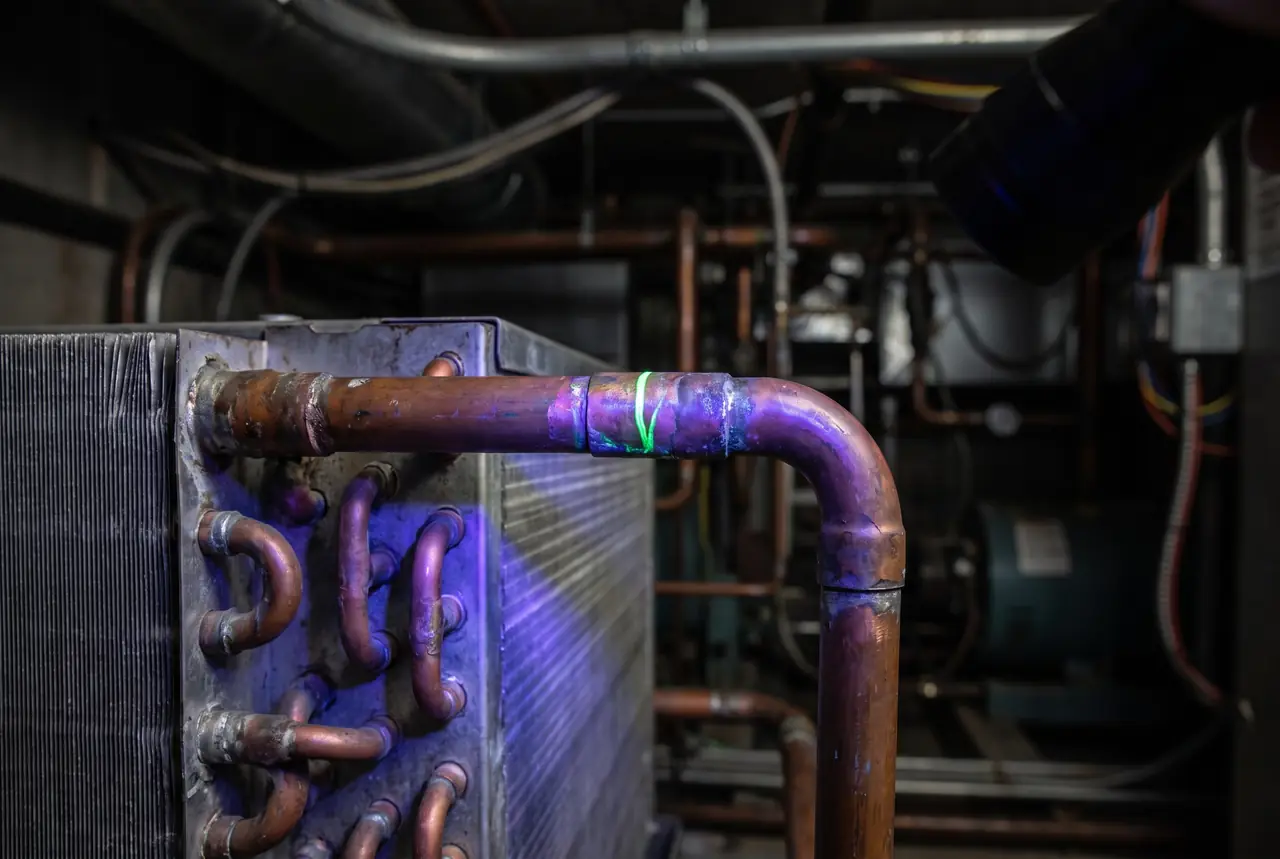
Ultraviolet dye for the slow ones
An intermittent leak that shows up only under load gets dye and a scheduled return visit, at no extra call-out charge.
A written verdict
You get told where the leak is, whether it is repairable, and what a repair is worth against the age of the system.
What to do in the twenty minutes before we arrive
Four things, in this order. Two of them can turn an expensive repair back into a cheap one.
Switch the thermostat to off
Not to a higher temperature. Off. A system calling for cool with a failed component keeps trying, and that is how a $200 capacitor becomes a $2,400 compressor.
Check the breaker once
Find the AC breaker, and if it has tripped, reset it one time. If it trips again, leave it off and tell the dispatcher, because that single fact changes what we bring.
Pull the filter and look at it
If light does not pass through it, that may be the whole fault. Take it out and leave the system off while the coil thaws. Tell us the size and we will bring a replacement.
Clear the path to both units
Outdoor unit and indoor air handler, including the attic hatch and a place to put a ladder. Every minute we spend moving storage boxes is a minute of your evening.
- 4
- parts that cause most summer failures
- 2 yr
- warranty on every part we fit
- 1 yr
- warranty on our labour
- 22
- trucks carrying capacitors and motors
Repair questions
What actually breaks most often?
Run capacitors, by a wide margin. They are a cheap component that lives inside a metal box sitting in 115 degree sun, and heat is what kills them. After that: contactors with pitted or welded points, condenser fan motors, and clogged condensate drains tripping the float switch. Compressor failure is much rarer than the industry likes to imply, and any company that reaches for it as a first diagnosis deserves a second opinion.
How do you find a refrigerant leak?
Electronic detection first, then a nitrogen pressure test to hold and isolate, then ultraviolet dye if the leak is intermittent and we need to come back to it. What we will not do is top up the charge, take your money and say nothing. Refrigerant that went somewhere will keep going there.
What does a diagnostic cost?
A flat $89, credited against the repair if you go ahead. You get the price of the repair in writing before any work starts. We do not quote hourly, so a slow diagnosis is our problem and not your bill.
What should I do while I wait?
Switch the thermostat to off rather than leaving it calling for cool, because a system running with a failed component can turn a cheap repair into an expensive one. Open the electrical panel and check whether the AC breaker has tripped. If it has, reset it once. If it trips again, leave it off and tell the dispatcher, because that changes what we bring on the truck.
Should I repair or replace?
Our working rule: if the repair costs more than a third of a replacement and the system is past year twelve, replacement usually wins. Two things override that arithmetic. An R-22 system with a failed compressor is almost never worth repairing because the refrigerant is out of production and the parts supply has dried up. And a system still inside its compressor warranty is often worth keeping even when it looks marginal on paper.
No cooling right now?
Tell the dispatcher which line on the board matches what you are seeing and the right parts leave with the truck.